Public transport… Maybe Make it Better
As many students get older, they transition from schools that are close by to universities that are not necessarily around the block, thus they discover the PTV network.
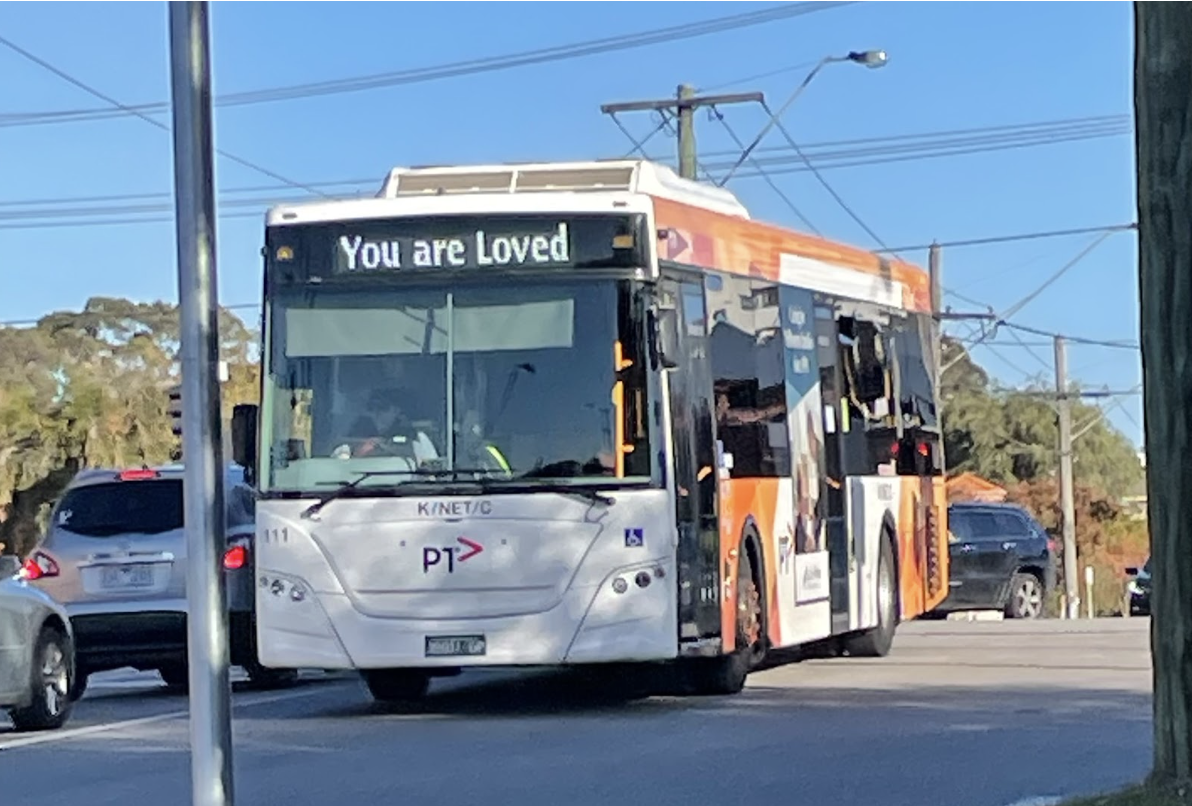
“You are Loved'“ Supplied: Yash Sharma
During the early honeymoon stages, everything seems as good as gold. Then the delays start happening; the stress of missing mandatory classes kicks in, and cancelled services appear left and right. In many cases, this frustration is slowly turning to anger and driving people away from public transport.
A couple of weeks ago, I was taking the bus to university when an elderly man with a walking stick boarded. Before he was able to sit down, the bus driver took off suddenly, and he was nearly thrown off his feet. Luckily, he was able to catch hold of the seat handle in time. This near-fall accident left the old man furious as he confronted the bus driver for his lack of consideration while he was merely trying to board.
As it turned out, the bus driver’s shift finished, because at the very next stop, he performed his handover to the next driver. It seems as if there was some kind of PTV position crisis, and in haste, the government had approved many inattentive and unreliable individuals who cared more about finishing their shift than their duty of care.
Major campaigns have been launched on the basis of garnering respect for PTV workers, the most recent of these being in 2025. It was identified by unions and government investigations that the abuse facing PTV workers was reaching an all-time high, surrounding particular issues such as fare evasion and service delays.
However, this behaviour by bus drivers and delayed PTV services may have underlying causes such as their unfavourable working conditions and pay.
What exactly are the underlying issues that are leading to these fissures being formed?
It has been identified by unions and government investigations that fare evasion and delayed services are a major cause in the rise of abuse. In 2023 alone, the Pakenham line saw 3.1% of trains being cancelled, affecting not only city commuters but also university students. However, with personal and student experience their seems to be no change in the transport system. Hence, network workers’ slogan for this campaign is “We’re just doing our job”.
The Victorian Government has attempted through multiple channels to curb the disrespectful behaviour being displayed through the implementation of authorised officers throughout train stations and bus terminals across metropolitan Victoria. A report released on the 17th of May 2019 outlines that there have been 1100 reports of threatening or abusive behaviour since 2016.
First-year student Sarah Kwan said that once her bus was so delayed that going back home was a better option than going to class and arriving an hour late.
The lack of reliable transport has students flocking to universities by car, jamming up parking spaces and causing more road traffic. However, parking at institutions may not be a more economical option compared to public transport. While Metro Victoria caps daily fares at $11.40. University parking includes parking costs plus petrol costs. Monash University caps parking at $5.70 for students and has Mondays and Fridays currently free. In contrast, Melbourne Uni has parking for $39 due to more public transport (trains, trams, buses) accessibility in comparison to Monash, which only has buses.
Sarah also mentioned how her 15-minute drive becomes “1 hour and 15 minutes when I don’t have my car”
These events are more than relatable to anyone who uses the Public Transport Victoria system; however, we have been conditioned to accept the flawed system without pushing for change. We must not. Changes must be made for fairer wages and better convenience
REFERENCES
Dawson, S., Serafim, P. and Lowe, C. (2017). An Investigation into Abuse and Assault of Route Bus Drivers: Statistics, triggers, Risk reduction, training, and Opportunities. [online] Available at: https://www.busvic.asn.au/sites/default/files/uploaded-content/website-content/Resources/Reports_Articles/abuse_and_assault_of_victorian_route_bus_drivers_june_2017.pdf.
Edwards, C. (2025). Why Victoria’s New worker-harm Laws Matter for Bus Drivers. [online] Australasian Bus and Coach. Available at: https://www.busnews.com.au/why-victorias-new-worker-harm-laws-matter-for-bus-drivers/
Yussuf, A. (2023, April 17). Melbourne's most unreliable trains on Craigieburn, Werribee and Pakenham lines. ABC News. Available at: https://www.abc.net.au/news/2023-04-18/melbourne-train-services-craigieburn-werribee-pakenham-delays/102232180
Monash University (n.d.). Parking. [online] Monash University. Available at: https://www.monash.edu/about/our-locations/transport-parking/parking
Porich, J. (2018). Parking on Campus. [online] About Us. Available at: https://about.unimelb.edu.au/news-resources/campus-services-and-facilities/transport-and-parking/parking-on-campus
State Government of Victoria (2024). Duty of Employees. [online] www.vic.gov.au. Available at: https://www.vic.gov.au/safework/safework-general-module/duty-employees
Vic.gov.au. (2019). Next Stage of Staff Safety Campaign. [online] Available at: https://www.premier.vic.gov.au/next-stage-staff-safety-campaign
Worksafe (2018). Transport, Logistics and Warehousing: Safety Basics - WorkSafe. [online] Vic.gov.au. Available at: https://www.worksafe.vic.gov.au/transport-logistics-and-warehousing-safety-basics